Introduction
Search for "spam words list" and you will find pages with hundreds of entries: *free*, *guarantee*, *amazing*, *click*, *opportunity*, even *dear* and *hello*. Follow all of them and you cannot write a sentence. Ignore all of them and some of your messages will read exactly like the spam those lists were built from. The truth sits in between, and it is more useful than either extreme: words are a weak signal on their own, and a strong one in the wrong context.
This post explains how modern filters actually treat vocabulary, which categories of language still cause real damage in cold email, and how to rewrite them without sounding like you are tiptoeing around a filter.
Why spam word lists mislead
Most spam word lists date from an era when filters were largely keyword-driven. A message containing enough flagged terms crossed a threshold and was junked. That era is over at the large mailbox providers. Gmail, Outlook.com and Yahoo classify mail with machine-learning systems trained on enormous volumes of user feedback — what people mark as spam, what they rescue from spam, what they reply to — and the biggest inputs are about the sender, not the vocabulary: domain and IP reputation, authentication, complaint history and how recipients engage.
You can see this every day in your own inbox. Retailers send "FREE shipping, today only!" to millions of people and it lands in Promotions, not spam, because the sender is authenticated, consistent and wanted. A brand-new domain sending a polite, word-perfect cold email can still land in spam, because nothing about the sender has earned trust yet. The same words, opposite outcomes. Reputation is doing the deciding.
Where words still matter
Words have not stopped mattering. They matter in three specific ways.
Rule-based filters still score phrases
Plenty of mail does not go to Gmail. It goes to companies whose mail passes through a security gateway, a hosting provider's server or a self-run mail system, and many of those still use rule-based scoring. Those filters carry body rules aimed at classic spam language, such as rules for advance-fee fraud wording and for large sums of money in the text. Each typically carries a small score. One will not push a message over the default threshold of 5.0. Several of them, plus an image-heavy layout and a listed link, will. In B2B cold email, where many recipients sit behind exactly these gateways, that is a real cost.
Words in combination with structure
Classifiers learn from combinations, not single tokens. Free in a sentence that explains a no-cost pilot is unremarkable. FREE!!! in the subject, next to a dollar figure, above a link to a shortener, in a message from a domain registered last week, matches the shape of millions of spam messages. The word is the same; the pattern around it is what the filter recognises. This is why the ratios matter — how much text against how many images, how many links against how many sentences, how much of the line is in capitals.
Words that make people press the spam button
This is the effect most guides miss, and in cold email it is the one that matters most. Promotional language makes a message from a stranger feel like an advertisement, and an unwanted advertisement is what people report as spam. Complaints feed straight into your domain's reputation at the provider, and Google and Yahoo hold bulk senders to a spam rate below 0.3% as measured by their own systems. The filter may let your hype-laden email through today; the recipients' reactions are what close the door next week.
The categories that still cause trouble
Rather than a list of hundreds of words, it is more useful to know the families. Each one below combines filter risk with reader risk, and each has a better alternative that is also better copy.
Money and income claims
Examples: earn extra cash, double your income, $$$, million dollars, best price, cheap. Money language is the most heavily patterned category because it is the core of financial scams. Specific, modest numbers tied to the reader's business read differently from vague, large ones — "cut onboarding from two weeks to three days" rather than "make more money".
Urgency and pressure
Examples: act now, limited time, expires today, urgent, don't miss out, last chance. Urgency from a stranger is a manipulation tell, and readers recognise it as quickly as filters do. Cold email has no deadline the reader cares about; give them a reason that belongs to their calendar instead.
Guarantees and too-good-to-be-true promises
Examples: guaranteed, risk-free, 100% satisfied, no catch, miracle, amazing results. Absolute claims cannot be verified in an email and invite scepticism. Replace them with evidence the reader can check: a named, public case study, or a concrete description of what changed and for whom.
Free and no-cost offers
Examples: free, free gift, no cost, no credit card required, bonus. You do not have to ban the word free; you have to stop shouting it. One plain mention in a sentence that explains what is free and why is fine. Free in the subject, in capitals or repeated, is not.
Pushy or generic calls to action
Examples: click here, click below, buy now, order today, sign up free. Generic link text on a link from an unknown sender is a phishing pattern, and "buy now" in a first-touch cold email is simply the wrong ask. The best cold email call to action is a question that can be answered with a reply.
Deceptive familiarity and fake transactional language
Examples: a Re: or Fwd: subject on a first message, as promised, following up on our call when there was no call, your invoice, payment failed, verify your account, action required. These are the worst category in this post. They imitate the messages phishing classifiers are trained hardest to catch, they break CAN-SPAM's rule against deceptive subject lines, and a reader who discovers the trick is the most likely of anyone to report you.
Formatting and obfuscation
Not words exactly, but they travel with them: whole lines in capitals, !!!, $$$, strings of emoji, spaced-out letters, and deliberately misspelt words such as fr33 or c-a-s-h. Obfuscation is worse than the word it hides. A filter that sees someone working to avoid a keyword learns more from the effort than it would have from the keyword.
Rewrites that work for the filter and the reader
| Category | Spammy version | Rewrite |
|---|---|---|
| Money | Earn $$$ with our proven system! | Here is how a team like yours cut the time spent cleaning lists — happy to share the details. |
| Urgency | Act now — offer expires Friday!! | If outbound is on your plan for next quarter, this might be useful before you set targets. |
| Guarantee | Guaranteed 3x more meetings, risk-free | Here is a public case study from a team about your size, if it helps. |
| Free | 100% FREE trial — no credit card! | You can try it on one campaign at no cost. |
| Call to action | Click here to book a demo now | Worth a 15-minute look next week? |
| Fake familiarity | Re: our conversation | Question about your outbound process |
| Formatting | AMAZING results!!! 🚀🚀🚀 | One plain sentence describing the specific result. |
Notice that none of the rewrites is a synonym swap. Replacing free with complimentary fools no modern classifier and reads worse. Each rewrite changes the stance of the sentence — from selling to someone, to being useful to someone — and the vocabulary follows from that.
What matters more than any word
If you have a limited amount of time to improve placement, spend it here first, roughly in this order:
- Authentication. SPF, DKIM and DMARC passing, with the From domain aligned. Gmail and Yahoo require it of bulk senders, and Microsoft began enforcing similar requirements for high-volume senders to Outlook.com in 2025.
- Sender reputation. A dedicated sending domain, warmed gradually — see the warmup ramp — and sending volume that grows steadily rather than spiking.
- List quality. Validated addresses and a relevant audience. Bounces and complaints outweigh anything you can do in the copy.
- Links and structure. Few links, on your own domain, no shorteners, no image-only bodies, a plain-text part, merge fields that render.
- Then the words. Remove the deceptive and pressure language first, then the shouting, then the rest.
And measure the right outcome. A phrase that does not move your spam score but lifts your reply rate is a good phrase. Our piece on deliverability metrics that matter covers which numbers to watch.
Check your copy instead of guessing
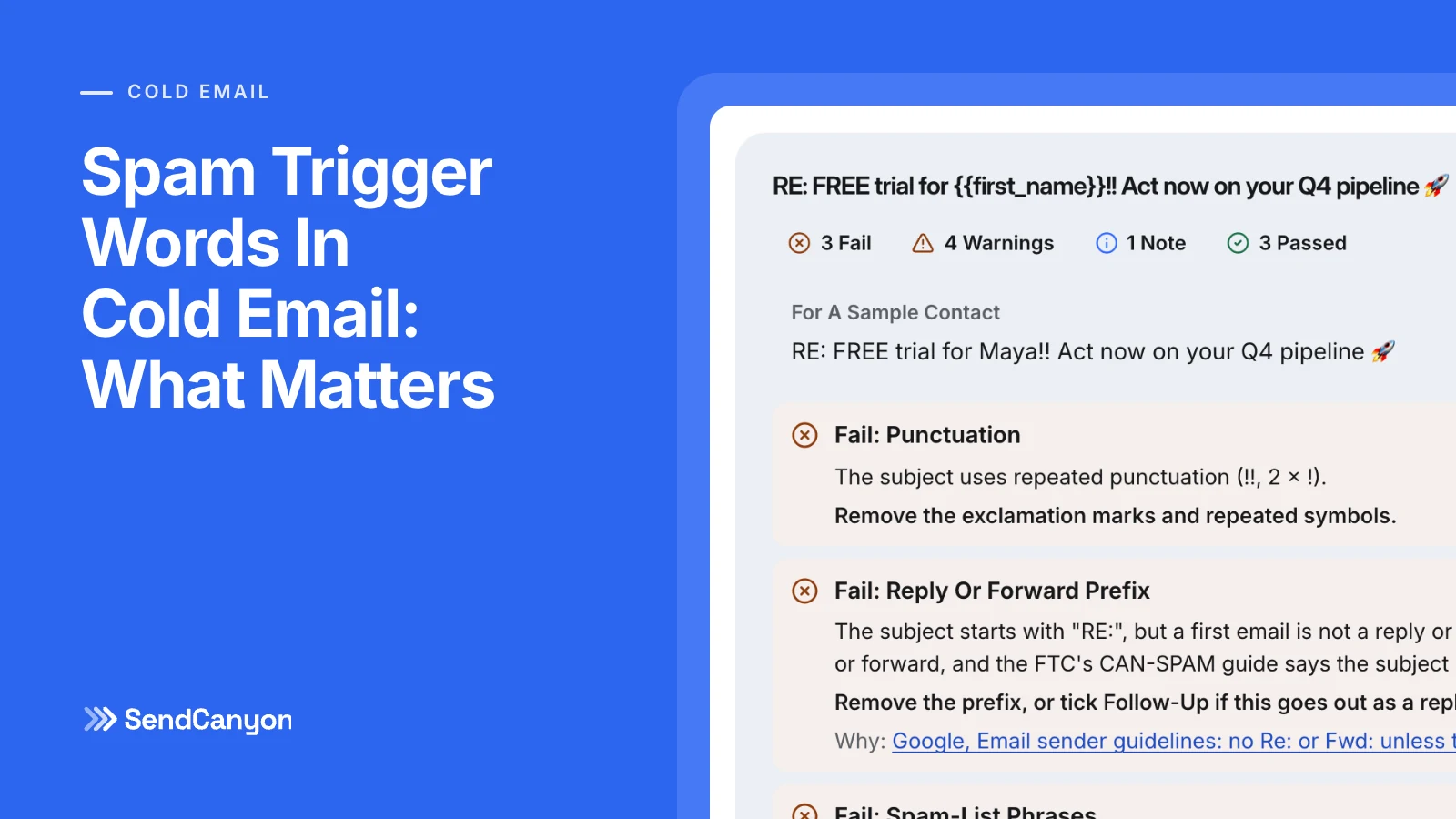
Because words matter in context, the practical move is to check a whole message rather than scan it against a list. Run a draft through the free email template checker to see which phrases and patterns stand out. In SendCanyon, the template checker compares your copy against a spam phrase list our team maintains, flags money and pressure wording, capitals, exclamation marks, emoji and deliberately misspelt trigger words, and scores the whole message with our spam filter so you can see whether any of it actually moves the number. Each check is marked Failed, Warnings or Passed, and Help me fix it has SpirenAI suggest the smallest rewrite that clears the flags while keeping your voice, links and merge fields. For the full testing workflow, read how to test your cold email template for spam.
Write like one person with a specific reason to contact another. Most spam words disappear on their own when you do.
Keep reading
- Cold EmailA Cold Email Spam Check Teardown, Before And AfterWe ran a badly built cold email through a spam check, fixed it in five rounds and logged the score each time. Removing spam words was the smallest fix.10 min read
- DeliverabilityLinks In Cold Email: What We Tested And What Gets FlaggedHow many links can a cold email carry, and which ones get it flagged? We tested shorteners, redirects, IP links and blocklisted domains through a spam filter.8 min read